
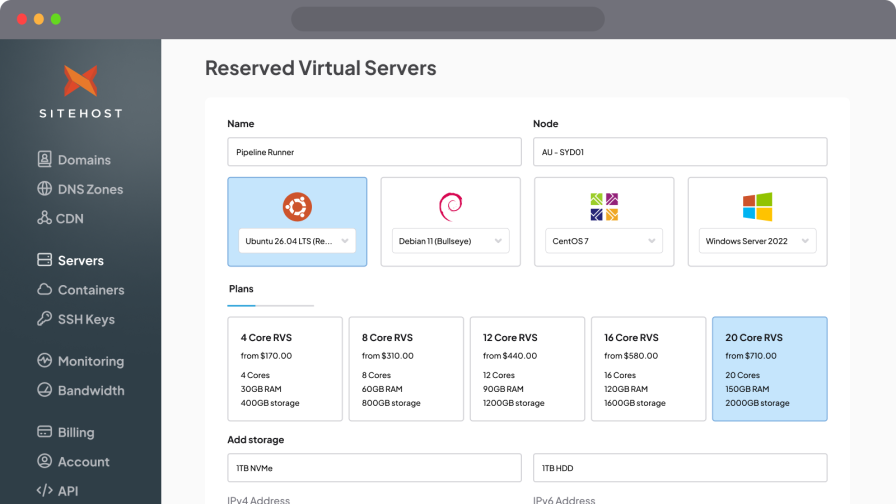
If you’ve been looking in the ‘Add Service’ section of the SiteHost Control Panel today, you might have spied a new category of server on offer. Reserved Virtual Servers (RVS) are an evolutionary step up from our old line of Virtual Dedicated Servers—a better way to fill the gap between Virtual Servers and Dedicated Servers.
If a traditional Virtual Server doesn’t fit the bill—perhaps you’re running a large applications, or you have privacy requirements to meet—and the prices of Dedicated Servers look a bit high, then take a close look at RVS.
Does that name seem familiar to you?
You’re probably well aware of ‘reserved instances’ that other cloud hosts offer, and Reserved Virtual Servers reflect that name for good reasons. Two big similarities are:
Reserved CPU cores and RAM. These components are dedicated entirely to you.
Fixed pricing locked in for terms of 12-36 months. That means no bill shock and no surprises in these times of ongoing hardware price spikes.
But Reserved Virtual Servers have some unique features as well. Let’s take a quick look at what they bring to the table, thanks to the magic of modern virtualisation.
Tiered, customisable storage
Every RVS starts with a decent whack of fast NVMe storage, from 400 to 2000GB depending on your plan. You can add extra terabytes on top of that, and when you do you can mix and match NVMe—the fastest storage that we offer—and cost-effective HDD storage.
There are ceilings, but you can still go big. On the 20 Core plan, total storage can range from 2TB to 17TB. The 4 Core plan can be expanded from 400GB to 5.4TB.
HDD is almost one-third the cost of NVMe, making it perfect for archiving away data that you don’t need to access frequently. With tiered storage your RVS can read and write to either data source, and it’s up to you what you store where. Just make sure that you use HDD as it’s intended—for data you don’t access too frequently and when speed isn’t important.
Unlike CPU cores and RAM, drives are shared between servers. To make sure that everyone has fair access to their drives, we’ve capped the number of read/write events that your server can execute per second. These IOPS limits differ for each type of drive, obviously. NVMe drives are so quick that limits will only kick in if something very unusual is happening. But HDD is a different matter. If your neighbour tries to overload your shared HDD, they’ll be slowed down and you’ll still be able to get through the door.
Related article: The history of storage 2007-2023 shows that NVMe IOPS can outpace HDD by up to 1667x.
Quick and easy backups and restores
In the days of VDS backups were, frankly, a weakness. No longer.
With RVS you have the option of adding our full backup service. Daily backups, stored offsite for 14 days. Even if you’ve maxxed out 17TB of storage, we’ll back it up all up for you.
But of course, a backup is only as good as its restoration. You might think that backups that big would mean a lot of downtime. Think again.
An RVS can be booted within minutes of a backup restore being started, no matter how much data is being brought back. Data will continue to sync in the background while your server is up and running. Streaming restores, as they are called, are a big step up.
It’s possible for you to manage your own backups rather than add our paid service. But by the time you’ve priced up an offsite server big enough to hold multiple backups of your RVS, you’ll appreciate the value in getting us to handle it.
Security and privacy
When it comes to security and privacy, there used to be a bigger gap between Dedicated Servers and virtualised ones. While RVS doesn’t completely match bare metal, it comes a lot closer than you might expect.
Private VLANs, or closed networks, are available as an additional service. There are some aspects of configuration that you ought to be aware of, like every server on a private network needing to be in the same location, so take a look at Private VLANS on the Knowledge Base.
Firewalling to restrict network traffic is now in your toolkit as well. There are two systems that work together here—collections of firewall rules called security groups, and server firewalls themselves. Our knowledge base explains it all.
The fact that RVS provides dedicated CPU cores can also meet security requirements that Virtual Servers don’t satisfy.
Carefully selected hardware locked in for 12-36 months
The RVS platform is built on AMD EPYC Milan series CPUs. These are very reliable chips from the 3rd generation of their family. While they’re not the newest, they comfortably outperform our Standard Virtual Servers. (If performance is your number one priority, then it’s still worth looking into our incredibly quick High Performance Virtual Servers.)
There’s another important consideration these days, which is the availability of components in a time when shortages of RAM and other hardware are roiling the industry. The CPUs, RAM, and NVMe and HDD drives inside our Reserved Virtual Servers are all from supply lines that we’ve worked hard to redesign in tricky times. (The same effort has let us offer a refreshed suite of Dedicated Servers this month as well.)
Lock in a fixed price RVS today and you’ll know what you’re paying for all that hardware for the next 12, 24, or 36 months. We’ve seen some truly eyewatering wholesale prices lately, and there’s no telling when RAMageddon will finally end. Fair, certain prices are worth more now than they have been for a long time.
The very-not-secret ingredient: modern virtualisation
In a sense, we started working on the RVS platform a few years ago. That’s because it’s built on KVM-based virtualisation that debuted on High Performance Virtual Servers in 2023 and was rolled out to Cloud Containers the next year. Those milestones marked the point where the old VDS platform really started showing its age.
That’s especially true because, unlike many other parts of the tech stacks that we operate, virtualisation layers can have very long lifespans—like 15 years or so. As we wrote when the Cloud Container platform got the upgrade, that means that a lot of new features arrived all at once. That article from 2024 is still relevant today: Expanding our newest and best virtualisation technology.
Or if you’d rather see for yourself what RVS can do for you, provision a new Reserved Virtual Server in Auckland or Sydney today.
VDSunset
This launch of Reserved Virtual Servers means that we’ve stopped offering new Virtual Dedicated Servers. That older product line came with more trade-offs, like a forced choice between faster performance or more storage. But for anyone already on the VDS platform there’s nothing to worry about.
Every VDS that’s already in service will stay in service, unchanged. Same price, same features, same management and support. If you’re happy with the VDS that you’re running, then keep running it. Simple.
If you think that a move to RVS might be worth making, then the first step is to talk to us. There is no straight upgrade path but we’ll be happy to investigate your options.